Rakyat Digital and the Future of Digital Learning in Malaysia: Access Is Only the Beginning
By Fadzil Ashraf, Founder, ThinkLab eLearning Solutions
Malaysia's digital learning landscape is continuing to evolve, and one of the most interesting recent developments is the Rakyat Digital Global Learning Pass.
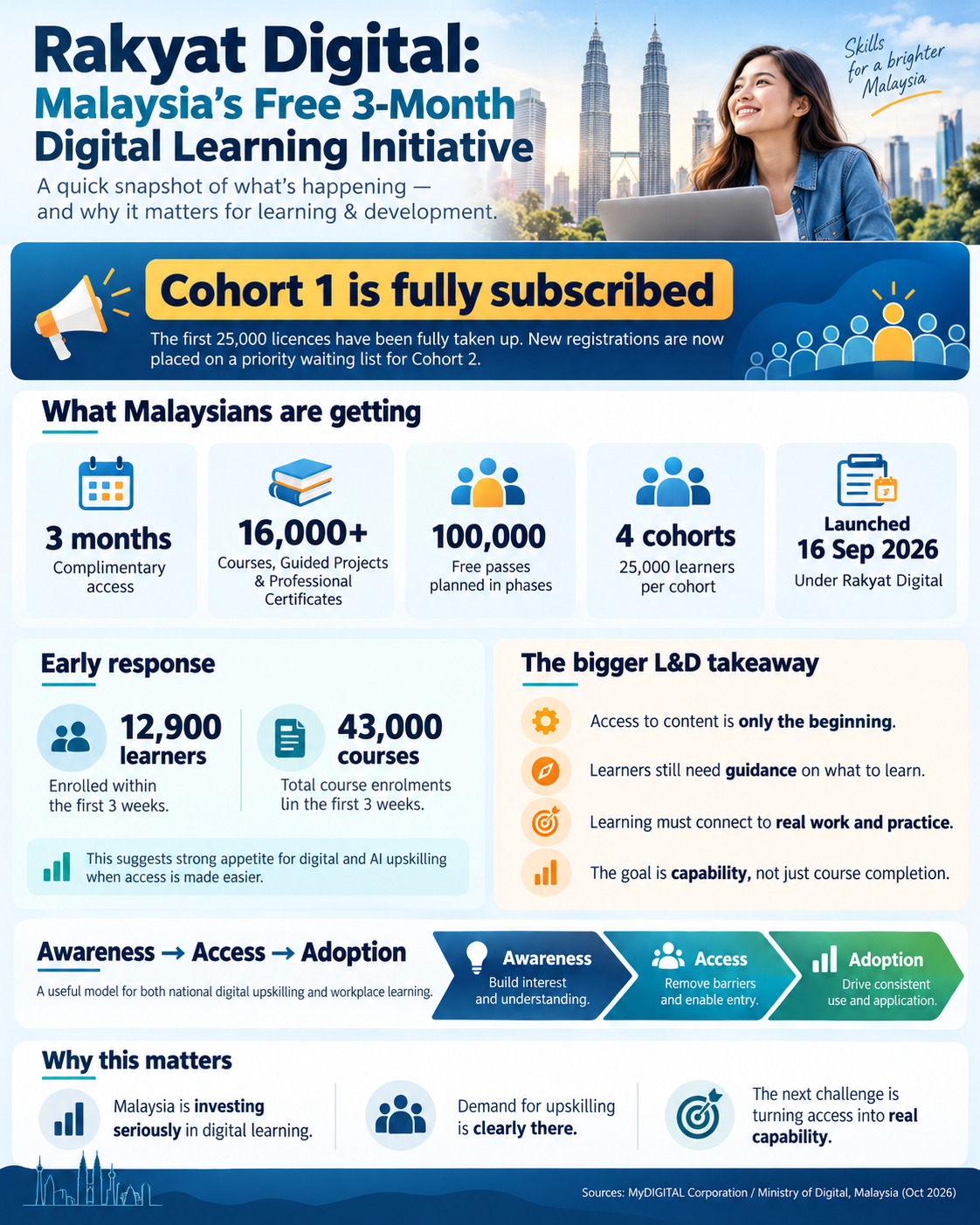
Through this initiative, the Ministry of Digital, via MyDIGITAL Corporation, is providing Malaysians with three months of complimentary access to Coursera, covering more than 16,000 courses, Guided Projects and Professional Certificates.
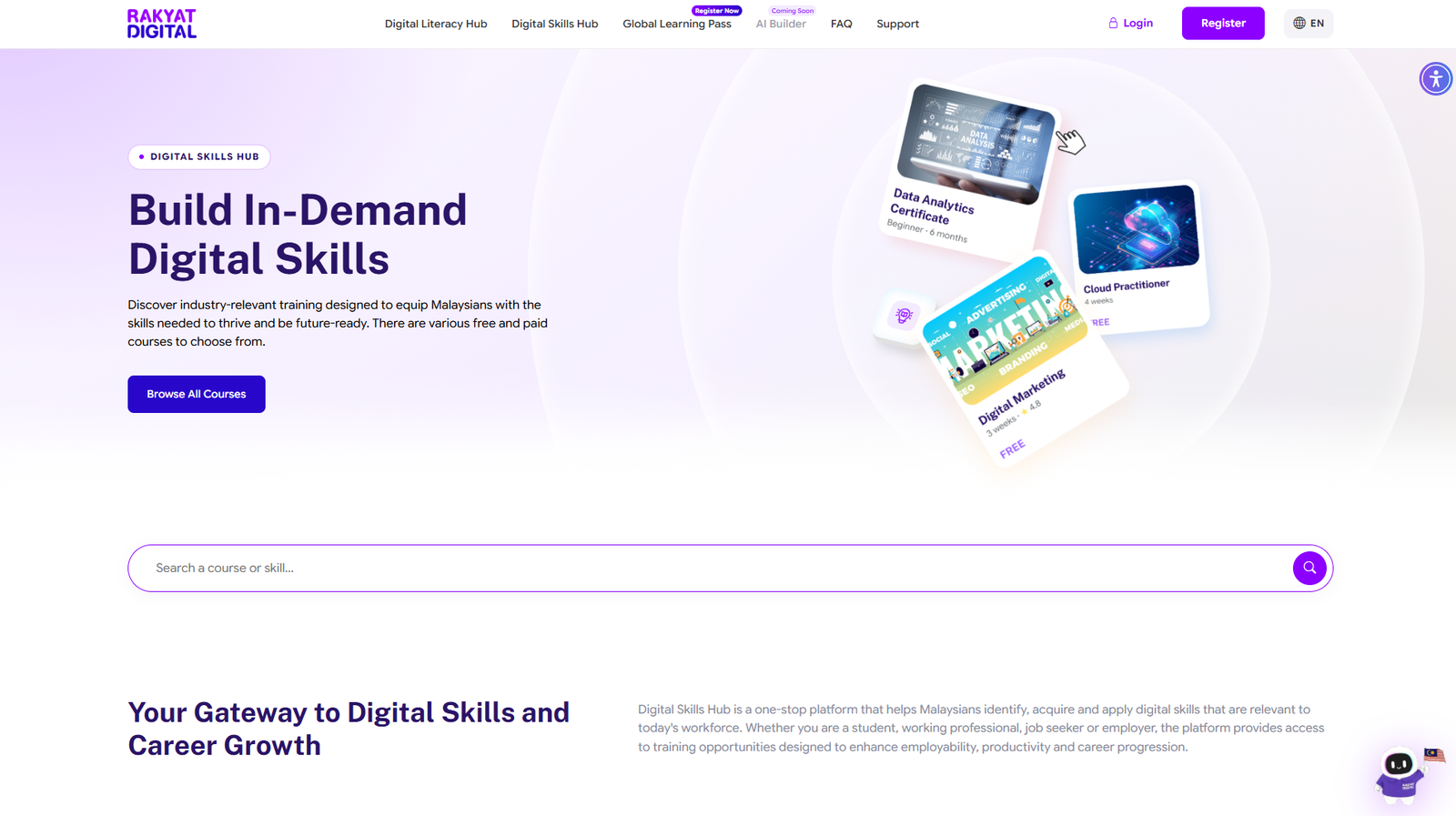
The available learning spans areas such as artificial intelligence, technology, data science, business and digital literacy.
A total of 100,000 free passes are planned to be made available in phases over one year.
The response has already been significant.
The first cohort of 25,000 licences has been fully subscribed, and new applicants are now being placed on a priority waiting list for the next cohort.
For Malaysia's Learning & Development community, though, the more interesting story may not simply be that thousands of courses are now available for free.
The bigger question is:
What happens after access is given?
Malaysians are clearly interested in digital upskilling
Early participation figures offer a strong indication of demand for digital learning in Malaysia.
According to MyDIGITAL Corporation, approximately 12,900 learners enrolled in 43,000 courses within the first three weeks of the initiative.
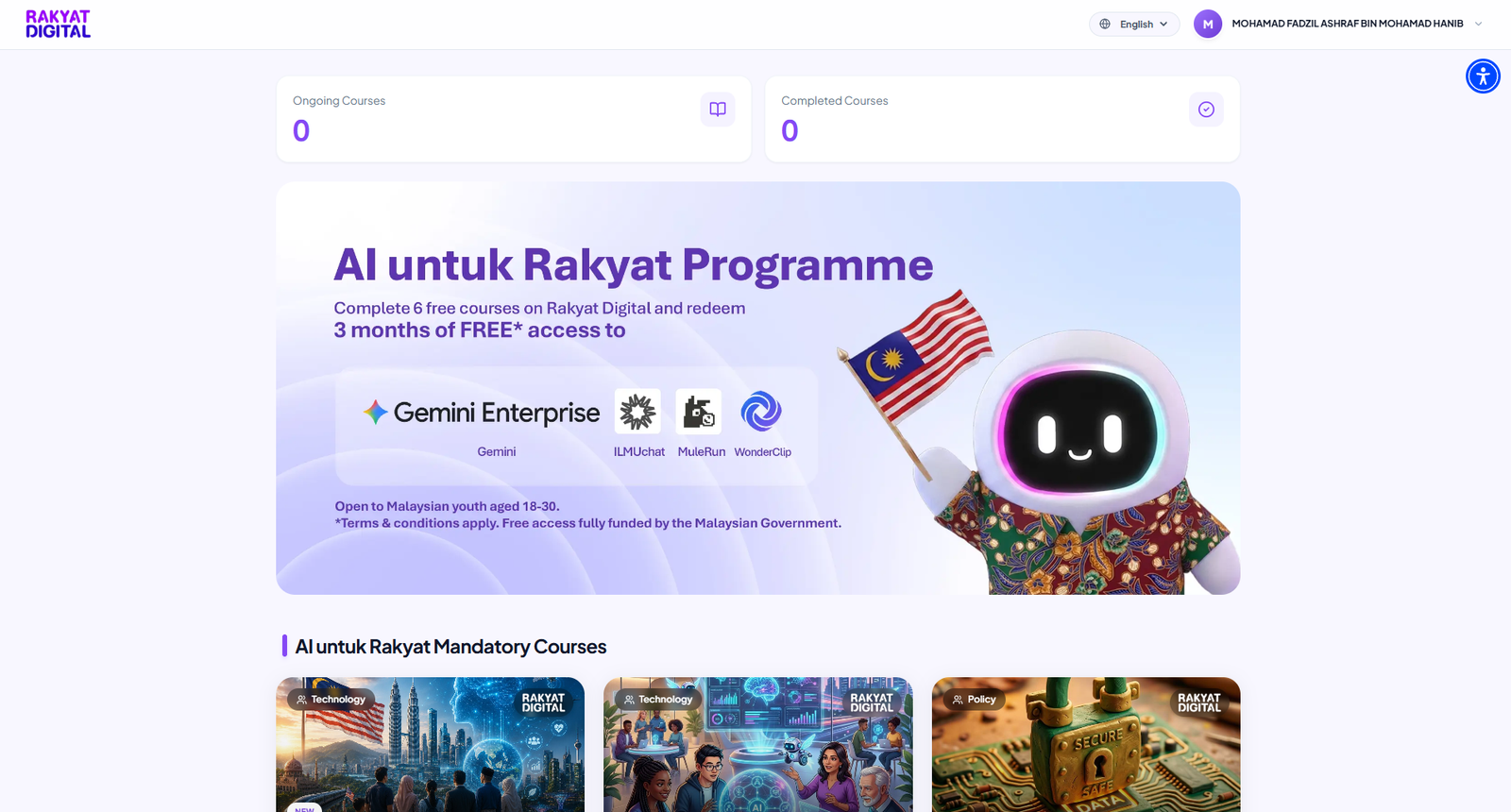
That represents more than three course enrolments per participating learner during the initial period.
Popular subjects included digital transformation, AI fundamentals, data and project management.
This suggests that Malaysian learners are not only curious about emerging technologies such as AI. There is also demand for practical, career-relevant skills that can support them in their current and future roles.
This demand is understandable.
The World Economic Forum's Future of Jobs Report 2025 estimates that 41% of workers' core skills in Malaysia are expected to change by 2030.
As technology continues to reshape industries, organisations and individual workers will increasingly need to treat learning as an ongoing process rather than something that only happens during onboarding or occasional training programmes.
In that context, initiatives such as Rakyat Digital are important.
They remove one of the biggest traditional barriers to professional development:
ACCESS.
But removing that barrier also reveals the next challenge.
Access to content is not the same as learning
Imagine opening a learning platform and seeing more than 16,000 courses available.
At first, that sounds like an enormous opportunity. But very quickly, another set of questions appears.
What should I learn first?
Which course is most relevant to my job?
Which skills are actually important for my career?
Should I complete a short introductory course or pursue an entire professional certificate?
And after completing a course, how do I apply that knowledge at work?
This is an important distinction in digital learning.
Having access to information does not automatically create capability.
Access removes a barrier. Learning design helps people navigate what comes next. This is where the role of Learning & Development becomes increasingly important.
Awareness → Access → Adoption
One aspect of the Rakyat Digital initiative that is particularly interesting is the framework used by MyDIGITAL:
Awareness → Access → Adoption
The idea is to help Malaysians move from understanding digital technologies towards accessing learning opportunities and, ultimately, applying those technologies in their studies, careers and businesses.
The same model can be useful when thinking about workplace learning.
Awareness
Before employees learn something, they first need to understand why it matters.
For example, telling employees that they need to "learn AI" is too broad.
Different groups need different levels of understanding.
A manager may need to understand how AI changes decision-making and team productivity.
A marketing employee may need to understand how generative AI can support content development.
Someone working in risk, compliance or legal functions may need to understand governance, privacy and responsible use.
Effective learning begins by creating relevance.
Access
Once people understand why something matters, they need access to suitable learning resources.
This could involve external learning platforms, internal eLearning, videos, workshops, microlearning, job aids, coaching or instructor-led programmes.
Platforms such as Coursera can be extremely valuable because organisations can provide employees with access to high-quality learning without needing to build everything internally.
But access alone does not guarantee application.
Adoption
The final question is whether learners can actually use what they learned.
Can they apply the knowledge in a realistic situation?
Can they make the correct decision?
Can they perform the task?
Can they use the organisation's actual systems, processes or procedures?
This is where digital learning often needs to move beyond simply presenting information. Practice, realistic scenarios, feedback, reinforcement and workplace application become important. The objective changes from:
"Did the employee complete the course?"
to:
"Can the employee now do something better because of the learning?"
What does this mean for organisations investing in digital learning in Malaysia?
For Malaysian organisations, the increasing availability of digital learning content presents both an opportunity and a challenge.
The opportunity is obvious. Organisations no longer need to develop every training programme internally. If employees need foundational knowledge about project management, data analytics, AI, cybersecurity, or communication skills, there may already be high-quality learning available externally.
The challenge is determining where generic learning ends and organisation-specific learning begins. External learning platforms cannot fully understand an organisation's internal environment. They do not know how a particular company operates, how its employees use internal systems, how its policies should be applied, or how its customers should be handled.
This means organisations still need learning that addresses areas such as:
- onboarding and organisational knowledge;
- internal policies and procedures;
- compliance and governance;
- product and service knowledge;
- customer-service scenarios;
- internal systems and workflows;
- risk processes and escalation procedures;
- leadership expectations; and
- role-specific workplace decisions.
This is where custom eLearning development and instructional design become particularly valuable.
Generic knowledge and organisational capability are different
Consider a bank employee. An online course can explain the fundamentals of risk management. But it cannot necessarily teach that employee how their organisation identifies, documents, escalates and reports a specific risk using its own internal framework. The same applies to onboarding.
A general course can explain how organisations work. But it cannot teach a new employee how their own organisation is structured, what each department does, what values guide the organisation or how internal processes work.
Healthcare provides another example. A healthcare professional may have access to excellent clinical information online.However, an organisation may still need structured digital learning around its own procedures, patient scenarios, standards, documentation requirements or continuing professional development programme.
The important distinction is:
External learning can develop broad knowledge. Custom learning helps translate knowledge into organisation-specific behaviour and performance.
These two approaches should not compete. In many cases, they work best together.
The future of L&D may be less about producing content and more about designing learning journeys
As learning content becomes easier to access, the role of Learning & Development may gradually shift.
Instead of asking:
"What course should we create?"
L&D teams may increasingly ask:
"What is the most effective learning journey for this performance requirement?"
Sometimes the answer will be a custom eLearning course.
Sometimes it may involve an existing external course.
Sometimes it could be a short video, interactive scenario, checklist, simulation, workshop, or job aid.
And often, it may involve a combination of these.
Imagine an employee who needs to develop data-analysis skills. They could begin by taking an external course covering the fundamentals of data analytics. The organisation could then provide an internal digital module explaining its own data, systems, governance requirements and reporting expectations.
The learner could then complete a realistic scenario that requires them to analyse information and make a workplace decision.
Finally, they apply the skill in their real job with support from a manager or subject-matter expert.
In this model:
- External learning builds knowledge.
- Internal learning provides context.
- Practice develops confidence.
- Workplace application builds capability.
That is a much broader role for L&D than simply managing an LMS catalogue.
More learning content does not automatically mean better learning
There has never been more learning content available. Coursera, LinkedIn Learning, YouTube and other platforms provide access to enormous libraries of educational material.
Generative AI can now create explanations, examples, summaries and quizzes within seconds. Organisations themselves often have years of training content stored across LMS platforms, PowerPoint presentations, videos and internal documents.
The challenge is increasingly not:
"Where can I find information?"
The challenge is:
"What information actually matters, and how do I turn it into something useful?"
This is one of the reasons instructional design remains important. Instructional design is not simply about taking existing PowerPoint slides and placing them inside an eLearning course.
It starts by identifying the required performance.
What should learners be able to do after the training?
What do they already know?
What mistakes are they currently making?
What information is essential?
What can be removed?
Where do learners need practice?
And how should the organisation know whether the learning actually worked?
Good digital learning answers these questions before deciding what the course should look like.
A positive sign for digital learning in Malaysia
The early response to the Rakyat Digital Global Learning Pass is encouraging. It demonstrates that Malaysians are willing to participate in digital learning when barriers to access are reduced.
It also reflects Malaysia's broader effort to strengthen digital and AI capabilities as the country moves towards its AI Nation 2030 ambitions.
For organisations, this creates an interesting opportunity. Employees may increasingly arrive at work having access to learning from universities, technology companies and global training platforms.
The responsibility of corporate L&D therefore becomes less about being the sole provider of knowledge. Instead, L&D can become the function that helps employees determine:
what to learn, why it matters, how it relates to their role and how to apply it effectively.
That is a significant shift.
From course completion to capability
One of the simplest measurements in digital learning is course completion. A learner starts a module.
They finish it.
The LMS records 100%.
A certificate may be issued.
But completion does not necessarily mean understanding. And understanding does not necessarily mean application. The more useful question is whether learning changes something.
Can the employee perform a task more accurately?
Can they make a better decision?
Can they respond appropriately to a customer?
Can they recognise a compliance risk?
Can they use a new system?
Can they apply a new process confidently?
This is where organisations can move beyond training activity and begin thinking about learning impact.
Access should be the beginning, not the end
The Rakyat Digital Global Learning Pass is a strong example of how technology can make high-quality learning accessible at scale. More than 16,000 learning opportunities are now available through the initiative, and the rapid uptake of the first cohort demonstrates that the demand is there.
But access is only one part of the learning journey. For individuals, the next challenge is knowing what to learn and how to apply it. For organisations, the challenge is connecting external knowledge with internal systems, processes, behaviours and performance requirements.
And for Learning & Development professionals, the opportunity is to design the bridge between the two. Perhaps the future of digital learning in Malaysia can be thought of as:
Awareness → Access → Practice → Application → Capability
Because ultimately, the objective of workplace learning is not to create more courses.
It is to help people perform better, make better decisions and develop capabilities that create value for both employees and organisations.
How ThinkLab supports digital learning
At ThinkLab eLearning Solutions, we work with organisations to transform existing content, policies, procedures and subject-matter expertise into structured digital learning experiences.
Our work includes instructional design, interactive eLearning development, digital onboarding, policy and compliance learning, scenario-based learning, animated training content and the modernisation of existing eLearning courses.
Our focus is not simply on putting information online.
It is on helping organisations turn content into competence through learning experiences that are structured, relevant and designed around real workplace needs.
If your organisation is reviewing its digital learning strategy, developing a new programme or modernising existing training content, visit **ThinkLab eLearning Solutions at thinklab.com.my to learn more.
Sources and Further Reading
MyDIGITAL Corporation — 8 October 2026
Ministry of Digital provides access to Coursera courses through Rakyat Digital for 100,000 Malaysians to advance the AI Nation 2030 vision
MyDIGITAL Corporation — 14 October 2026
Rakyat Digital Global Learning Pass: First Cohort of 25,000 Licenses Fully Subscribed; Waiting List Now Open