Better F&B Training: From Global Upskilling Trends to Malaysian Outlets
Your F&B team may know the rules. But can they apply them when the orders pile up?
A new employee has finished onboarding. The team has attended a food safety briefing. Everyone has received the latest standard operating procedures.
Yet, during a busy shift, a preparation step gets missed, a customer receives inconsistent information, or a supervisor has to explain the same process again.
Before assuming employees need another briefing, it is worth asking: does the training prepare them for the conditions in which they actually work?
For restaurants, cafés, catering businesses and foodservice groups, training needs to connect information with everyday decisions. Global and regional research helps explain why this matters—and how Malaysian F&B businesses can approach it.
The global picture: upskilling is becoming a business priority
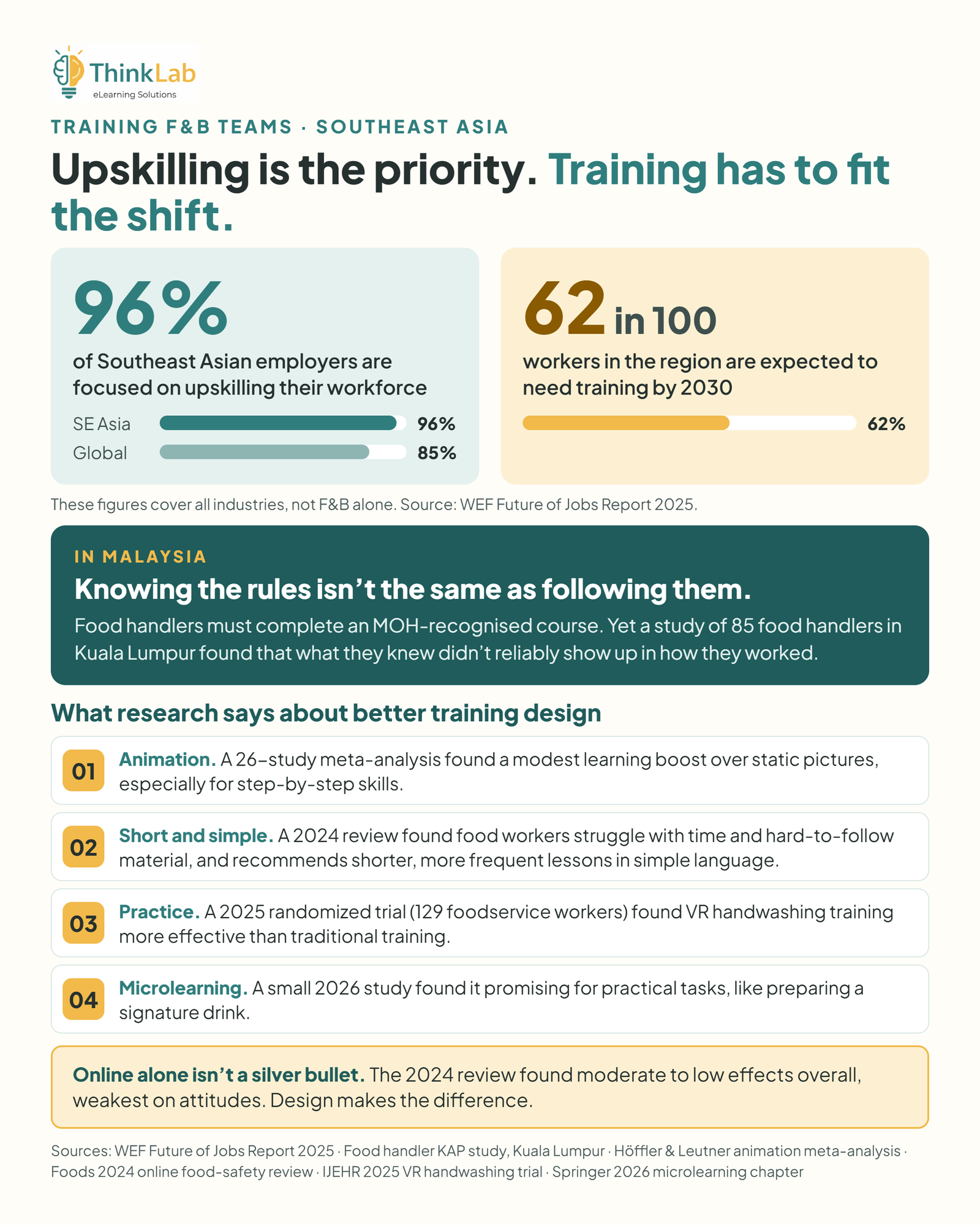
The World Economic Forum’s Future of Jobs Report 2025 found that 85% of surveyed employers globally plan to prioritise upskilling their workforce. It also estimates that 59 out of every 100 workers will need training by 2030. These are cross-industry findings, rather than figures specific to hospitality or F&B.
For F&B operators, the practical question is how to make that investment useful on the floor.
Employees need to understand procedures, recognise risks, communicate with customers and respond correctly when something unexpected happens. Providing more information is only part of that work.
Food-safety education research reinforces this point. A 2024 systematic review and meta-analysis found that online food-safety education had moderate to low effectiveness across the outcomes examined, with attitudes showing the weakest effects. Food workers faced barriers including limited time and difficulty understanding the material. The authors recommended shorter, more frequent training using simple language.
The implication is straightforward: putting a presentation online does not automatically make it effective training.
Digital learning needs a clear purpose, understandable content and opportunities to apply what has been learned.
Southeast Asia: strong demand for skills, with practical delivery challenges
The need for workforce development is particularly pronounced in Southeast Asia.
Drawing on its 2025 report, the World Economic Forum states that 96% of surveyed employers in the region see a need to invest in improving or adapting their existing workforce’s capabilities, compared with 85% globally. It also expects 62 out of every 100 workers in Southeast Asia to require training by 2030. Again, these figures cover multiple industries.
For an F&B business operating across outlets or countries, that creates a practical design challenge: how do you maintain a consistent standard while making training relevant to each team?
A useful approach is to separate shared operating standards from local requirements.
Customer service principles and brand expectations may be consistent across the business. Food safety requirements, language needs and specific operating procedures may need local versions.
Singapore illustrates why this distinction matters. The Singapore Food Agency requires food handlers in retail and non-retail food businesses to pass the WSQ Food Safety Course Level 1. Its framework also includes refresher training requirements. A company’s internal learning programme therefore needs to sit alongside the relevant national training framework.
For regional F&B groups, a shared digital learning foundation can support consistency, while country-specific content keeps the programme relevant to the people using it.
Malaysia: connecting training requirements with everyday practice
Malaysia’s F&B sector provides considerable scope for workforce development. The Department of Statistics Malaysia’s Economic Census 2023 recorded 136,453 food and beverage service establishments operating in 2022. This is a historical census figure, rather than a current outlet count.
Within that sector, training includes formal requirements.
The Ministry of Health states that the Food Hygiene Regulations 2009 require food handlers to undertake food-handler training at a Ministry-recognised training school. For halal-certified businesses, halal awareness training is also part of the certification framework; JAKIM’s guidance describes a recurring three-year training requirement.
Custom eLearning can support applying and reinforcing these requirements. It should not be presented as a replacement for recognised courses or required certification.
The opportunity lies in what happens between formal training sessions.
Can employees recognise a problem during receiving? Do they know who to contact when someone proposes an ingredient substitution? Can a new team member follow the outlet’s preparation sequence without relying on memory alone?
These are the moments where training needs to become practical.
What useful F&B eLearning looks like
At ThinkLab, we recommend starting with the tasks employees need to perform and the decisions they need to make. The format should follow those needs.
1. Build each short lesson around one task
A broad topic such as “food safety” can be difficult to translate into immediate action.
A focused lesson might instead address checking a delivery, following a cleaning procedure or escalating an ingredient concern.
Each lesson should make three things clear: what to do, why it matters and when to ask for help. Short lessons still need enough detail to teach the task properly.
2. Let employees practise realistic decisions
A scenario gives employees an opportunity to make a choice and understand its consequences before facing the situation at work.
For example:
- A delivery arrives with information that does not match the approved documentation. What should the employee do next?
- A customer asks about an ingredient the server cannot confidently identify. How should they respond?
- A colleague suggests skipping a preparation step during a rush. What is the appropriate action?
The feedback should explain the reasoning behind the correct response and connect it to the business’s approved procedure.
3. Design for the people using the training
For Malaysian teams, English and Bahasa Malaysia versions can be a useful starting point. Additional language support should reflect the workforce.
Use familiar terms, readable text, clear demonstrations and captions. Check whether employees can understand the instruction without having to interpret complicated wording.
Mobile-friendly delivery also needs practical planning: a suitable device, reliable access and allocated time to learn.
4. Connect digital learning with supervisor coaching
A digital lesson can introduce a process and demonstrate the expected standard. A supervisor can then observe the employee performing it and provide feedback.
For a signature drink, for example, an employee could review a short preparation demonstration, practise at the workstation and receive feedback against an agreed checklist.
This gives both the employee and the supervisor a shared reference.
5. Keep learning available after onboarding
Training should remain useful when menus change, procedures are updated or recurring mistakes appear.
Short refreshers and accessible job aids can help employees revisit the relevant information. A central source also makes it easier to distribute approved updates across outlets.
Measure performance as well as completion
Course completion tells you whether someone finished the learning activity. It does not, on its own, demonstrate competence.
For an initial pilot, choose one operational issue and define what improvement would look like. Depending on the topic, useful measures could include:
- Accuracy when performing an observed task.
- Recurring errors recorded by supervisors.
- Time taken to demonstrate a skill independently.
- Compliance with an approved workplace checklist.
- Relevant customer complaints or service issues.
Review the results alongside working conditions. If employees understand the procedure but lack the equipment, time or supervision to follow it, another module alone will not solve the problem.
A practical starting point for your F&B team
You do not need to digitise every SOP at once.
Start with one task that matters to your operation. Build a focused lesson, pair it with practical coaching and check whether employees can perform the task more consistently. Use what you learn to improve the next module.
eLearning gives manager-led coaching a consistent foundation to build on. Its value comes from helping employees apply the right information at the right moment.
At ThinkLab eLearning Solutions, we develop custom eLearning for Malaysian businesses using Articulate Rise 360, Storyline 360 and interactive HTML. We turn SOPs, safety standards and brand expectations into practical learning experiences in English and Bahasa Malaysia.
Whether you are strengthening onboarding, reinforcing approved food safety procedures or improving service consistency across outlets, we can help you plan an approach around your team’s work.
Have an SOP or recurring training challenge in mind? Email thinklab.elearning@outlook.com to discuss how it could become a practical learning experience.